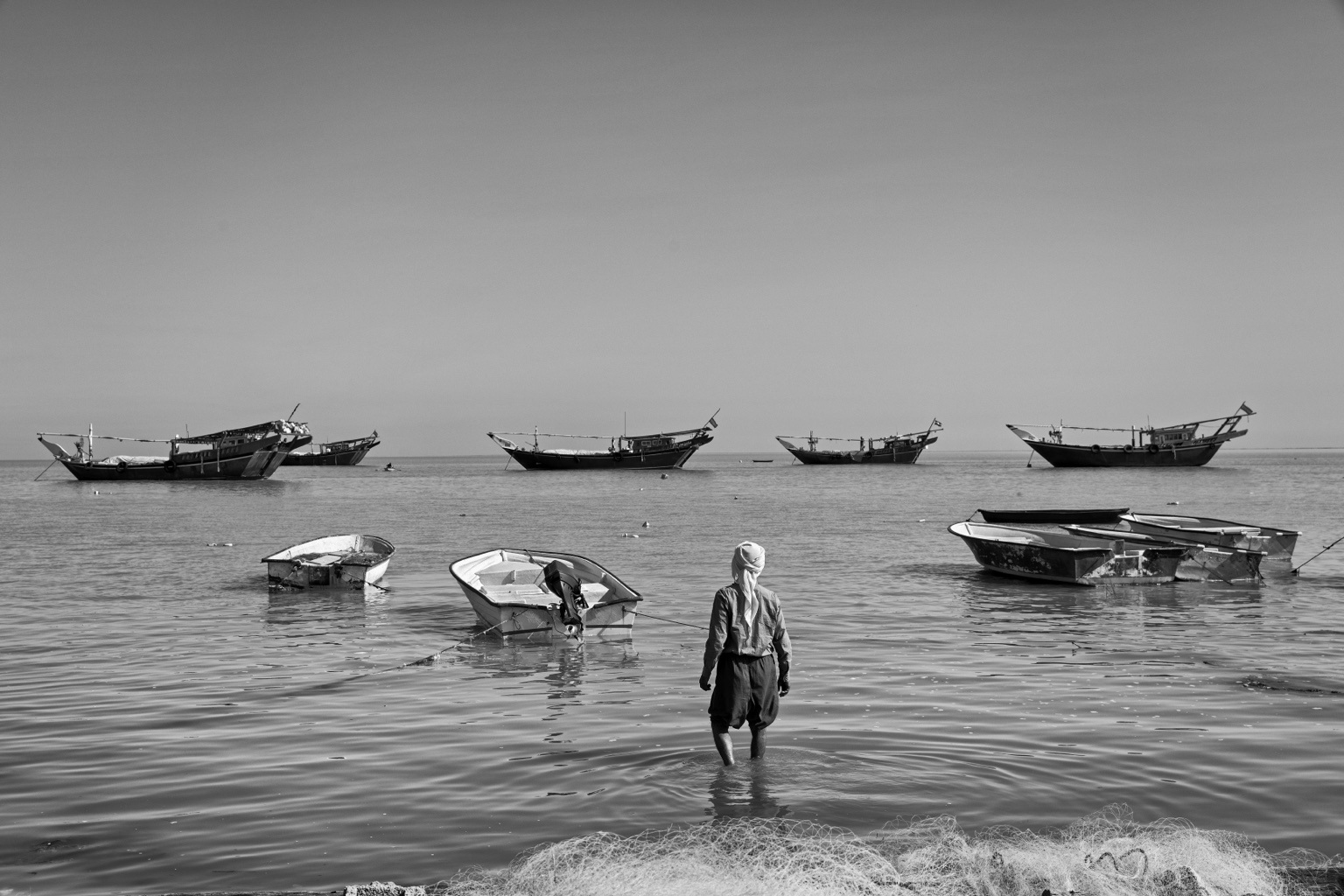
A fisherman carrying his catch through shallow coastal water

Documentary Photographer

Yaghoub
Hozori

Iran · Türkiye · Iraq · Norway

01

Selected Stories

01 / 05

The Sea Is a Lifeline

Bandar Abbas, Khorramshahr, Shif Island & Arvand Kenar · Iran, 2018–2019

Southern and southwestern Iran hold much of the country’s oil and gas wealth, yet many people in these regions still lack comfortable lives and sufficient employment opportunities. For many coastal families, the sea remains their last hope and most essential means of survival.

Men go out to sea and bring their catch back to the shore and the market. A short but vital journey connects the sea, the coast, and the home—a cycle that sustains families and continues from one generation to the next.

This series portrays people whose work, hope, and future are deeply tied to the sea—a generation that lives from the sea today, while the children of tomorrow grow up beside these same waters. Yet the question remains: what future awaits these children on the southern coast of Iran?

02 / 05

Date Harvest

Ahram, Bushehr Province · 2020

The date harvest in southern Iran takes place during the hottest months of the year. Local workers arrive in the palm groves early in the morning and climb the trees using simple tools. They cut the heavy clusters of dates, gather the fruit, and prepare it for transport. Amid the long hours of labor, moments such as preparing breakfast and drinking tea become part of their shared daily life in the grove.

Women also play an essential role in this cycle, from collecting the harvest to sorting and packaging the dates. This series follows the fruit from the top of the palm tree to the finished product, portraying collective labor, everyday life, and a livelihood that has connected generations to the palm groves.

03 / 05

Like a Shadow

Tabriz, Tehran & surrounding areas · 2019

In Iran, certain religious and cultural attitudes have shaped very different lives and destinies for dogs. Relatively few dogs live as companions within Iranian families. These dogs usually receive affection, food, medical care, and protection. Beyond the home, however, many dogs struggle to survive on the streets, along the outskirts of cities, and beside roads. Hunger, disease, traffic accidents, and human violence constantly threaten their lives, and many die unnoticed.

In recent years, volunteers and independent groups have worked to rescue these animals. They collect injured and homeless dogs and take them to shelters. Yet many of these shelters lack adequate facilities and depend largely on public donations to provide food, accommodation, and medical treatment. The responsibility rests mainly on volunteers who, despite limited resources, continue working to keep these animals alive.

‘Like a Shadow’ portrays three different destinies: the security of a home, abandonment on the streets, and life in a shelter after rescue. In each of these worlds, dogs remain close to humans like shadows—yet their fate depends largely on our choices and actions.

04 / 05

Until We Could Breathe Again

Tabriz · Iran, 2021

In the summer of 2021, the world was still gripped by the fear of the COVID-19 pandemic. The virus found its way into people’s homes through every possible opening, and our home was not spared.

Soraya had been unwell for several days. She was short of breath, but despite two visits to doctors, her illness was not correctly diagnosed. By 31 July, she could barely breathe. After an emergency examination at home, she was taken by ambulance to Valiasr International Hospital in Tabriz. Tests confirmed that she had COVID-19 and that more than fifty percent of her lungs were affected.

Soraya was admitted to the COVID ward, where news of another patient’s death came almost every day. Her daughter and I tried to remain hopeful in front of her, but in private, we lived with fear and anxiety. Every day, I searched pharmacies across the city for her medication. Eventually, we found some of the prescribed drugs in another city, at several times their normal price.

In the afternoons, we went to the hospital to see her, but we could only look at her through a window. During the first few days, she was unable to speak. Gradually, her voice returned, and hope began to appear on her face.

After ten days, Soraya was discharged from the hospital, but her treatment continued at home. Every day, I struggled to carry and replace the forty-kilogram oxygen cylinders she depended on. Her daughter and I never left her alone.

No one came to our home, nor did we visit anyone else. Within our own home, we fought illness, fear, isolation, and the shortage of medicine at the same time—but we never lost hope.

Soraya loved life, and perhaps it was this love that gave her the strength to fight. After forty days, she finally overcame COVID-19, and we understood, to the depths of our being, what a blessing health truly is.

05 / 05

Ashura in Kuh Kamar

East Azerbaijan Province · 2018

In Kuh Kamar, Ashura rituals unfold through linked rows, drums, raised sticks, shrouds, and acts of mourning. The presence of children and families shows how ritual enters a village’s collective memory and passes between generations.

PERSONAL MEMORY / 2018–2020

When I Was Nineteen

02

Selected Single Images

Independent photographs made across Iran, Türkiye, and Iraq, reflecting an ongoing attention to everyday life, cultural identity, memory, landscape, and quiet human gestures.

03

About

Photography as witnessing — and as social memory.

Yaghoub Hozori is an Iranian-Norwegian documentary photographer whose work focuses on cultural identity, rural Iran, social memory, and environmental themes. His visual language grows from the meeting of Middle Eastern textures and Scandinavian simplicity.

He is the founder and editor of Bakhish Collective, a photography platform dedicated to increasing the international visibility of Iranian photographers. His work has been presented in Oslo, Tehran, Tabriz, and Urmia.

04

Contact & follow

yahozori@gmail.com